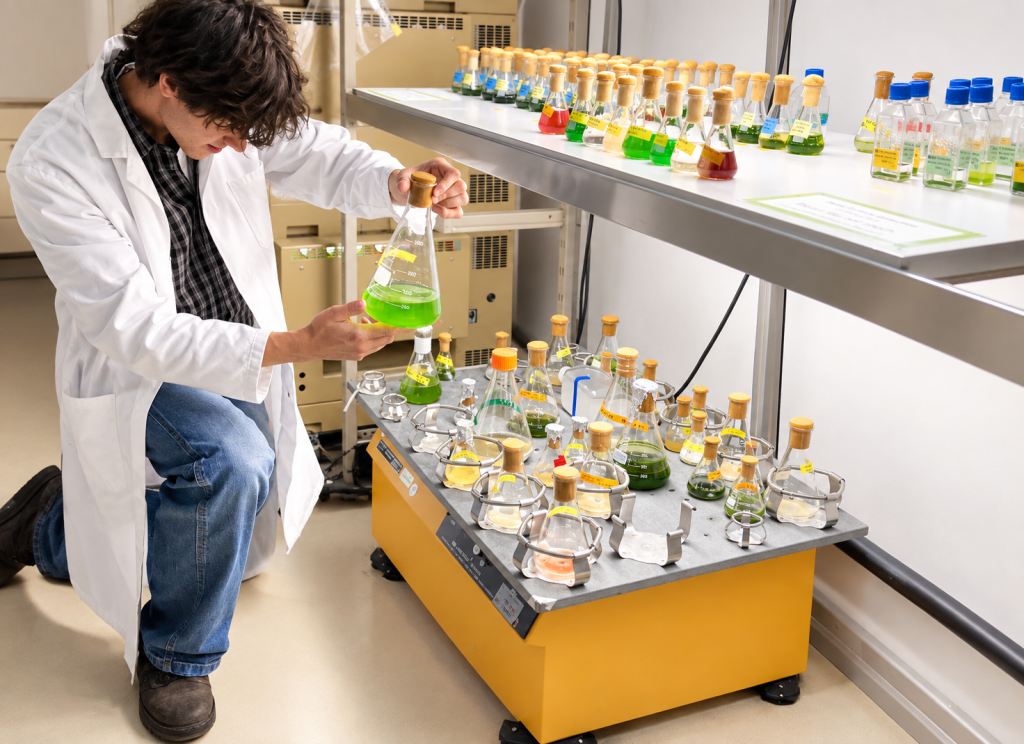

Sam Spence, an Earth Sciences master’s student at the University of Amsterdam and Climate Cleanup intern, is researching a potential new pathway for carbon dioxide removal: carbonated olivine.
The work explores whether a specially processed form of olivine could support mineral-based ocean alkalinity enhancement: increasing the ocean’s capacity to absorb CO₂ while helping counter ocean acidification.
Putting it to the test
Sam’s lab work tests whether this material can help grow diatoms: microscopic algae that play an important role in the ocean’s biological carbon cycle. Diatoms build their glass-like shells from silica, which carbonated olivine releases as it dissolves. The team is comparing diatom growth using carbonated olivine with growth using other silica feedstocks.
Diatoms are particularly interesting because of their role in the ocean’s biological carbon pump. They account for a significant share of global primary production (around 20%) and play an important role in biological carbon sequestration.
Sam and the team have achieved a proof of concept: diatoms can be grown using carbonated olivine from Green Minerals as a source of silica and carbonate. They are now investigating how much carbon this could sequester and what the ecological effects might be.
Bringing two carbon cycles together
For Sam, the appeal of the research lies in bringing two powerful natural carbon cycles together. Diatoms and other phytoplankton help move carbon from the atmosphere into the ocean. Enhanced weathering, meanwhile, accelerates a geological process through which rocks react with CO₂ and water, ultimately storing carbon in more stable forms. As Sam puts it:
“It’s something I’ve thought about for a few years. When I think about carbon dioxide removal, these are two of the most important processes I come back to.”
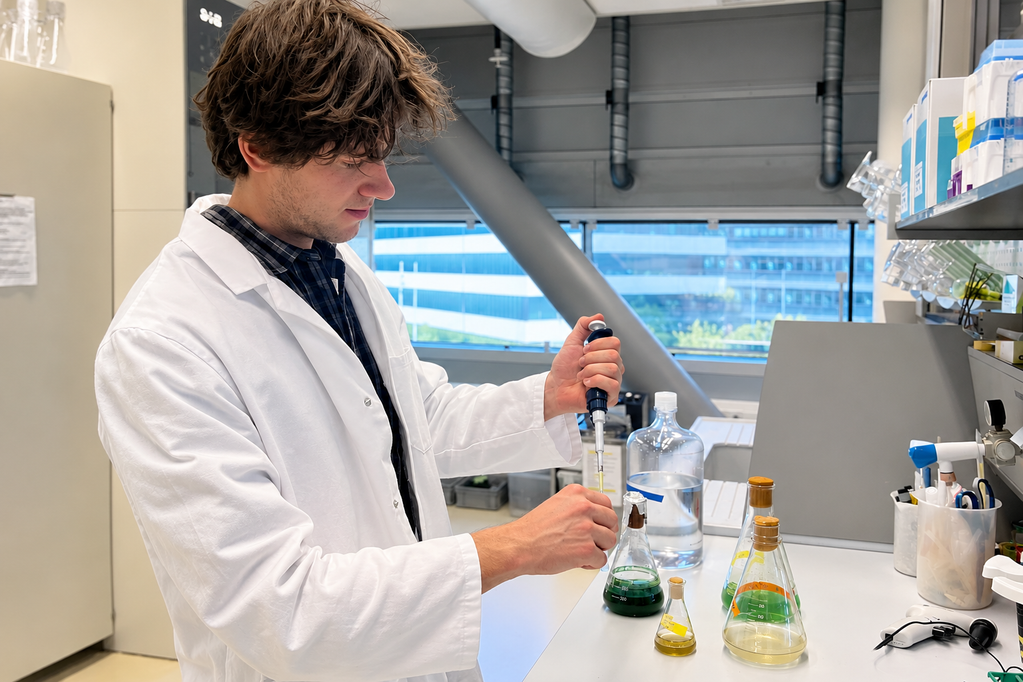
That is what makes the approach particularly interesting to him: rather than trying to invent an entirely new way of removing carbon, the research asks whether these existing processes can be supported and accelerated.
“I’ve always wanted to work on it because I think it has huge potential for scalability. I’m really happy I’m finally getting to research it.”
Why raw olivine falls short
Raw olivine has long attracted interest for carbon removal. But in seawater it dissolves slowly, sinks quickly because of its density, and can contain nickel at levels that require careful consideration.
Green Minerals have developed a reactor process that treats olivine under high pressure and temperature. The resulting fine material contains amorphous silica and magnesium carbonate. According to Sam, this carbonated material dissolves more quickly, is buoyant rather than sinking immediately, and has lower nickel content. Research also suggests that nickel can be extracted more easily from carbonated olivine than from raw olivine, although further work is needed to understand the material’s trace metal content and potential ecological effects.
From proof of concept to the field
The potential applications could extend beyond atmospheric carbon removal. Supporting diatom growth may also have relevance for biodiesel production, aquaculture and potentially managing harmful algal blooms in lakes and coastal waters. These possibilities would, however, require further research of their own.
Longer term, the research aims to develop a scalable carbon dioxide removal pathway. The next research phase would move beyond the laboratory into mesocosms (large enclosed experimental tanks) and, potentially, contained field trials. The team is currently seeking funding to continue the work. If you are interested in funding this research, contact Sam at sam@climatecleanup.org.
The research is still at an early stage, but it raises an intriguing question: can a carefully processed mineral help support marine biology while contributing to carbon removal at scale?