
Nature-based solutions, explained
Nature-based solutions are ways of meeting a human need, such as a stable climate, clean water or safe coasts, by working with living systems instead of against them. Here is what the term means, what nature can do for the climate, and how you can tell a real result from a claim.
What the term means
In 2022 the United Nations Environment Assembly agreed a shared definition. Nature-based solutions are actions to protect, conserve, restore, sustainably use and manage natural or modified ecosystems on land, in fresh water, on the coast and at sea, which address social, economic and environmental challenges effectively and adaptively, while providing human well-being, ecosystem services, resilience and biodiversity benefits (UNEA resolution 5/5).
So the test is twofold. The action has to solve a real problem, and it has to leave the ecosystem richer, not poorer. A row of fast-growing trees planted on a species-rich meadow may store some carbon, but it fails the second test.
What nature can do for the climate
For the climate, nature works in two ways that are easy to mix up:
Both matter. A widely cited study in PNAS found that natural climate solutions could provide about 37% of the cost-effective CO₂ mitigation needed by 2030 for a good chance of keeping warming below 2°C (Griscom et al., 2017). Climate Cleanup works on the second half, removal, because emissions cuts alone cannot bring back the carbon that is already in the sky. Our primer on nature-based carbon removal explains why.
Four places nature stores carbon
Land & soil
Regenerative farming, agroforestry, hedgerows, forests and rewetted peat. Carbon goes into wood, roots and living soil.
Ocean & coast
Seaweed, seagrass, salt marsh and mangroves take up carbon in coastal waters and bury part of it in sediment.
Rock
Enhanced weathering: crushed silicate rock such as olivine speeds up a natural reaction that binds CO₂ from the air.
Construction
Timber, hemp, straw and other plant-based materials keep the carbon the plants took up for as long as the building stands.
How much could the Netherlands do?
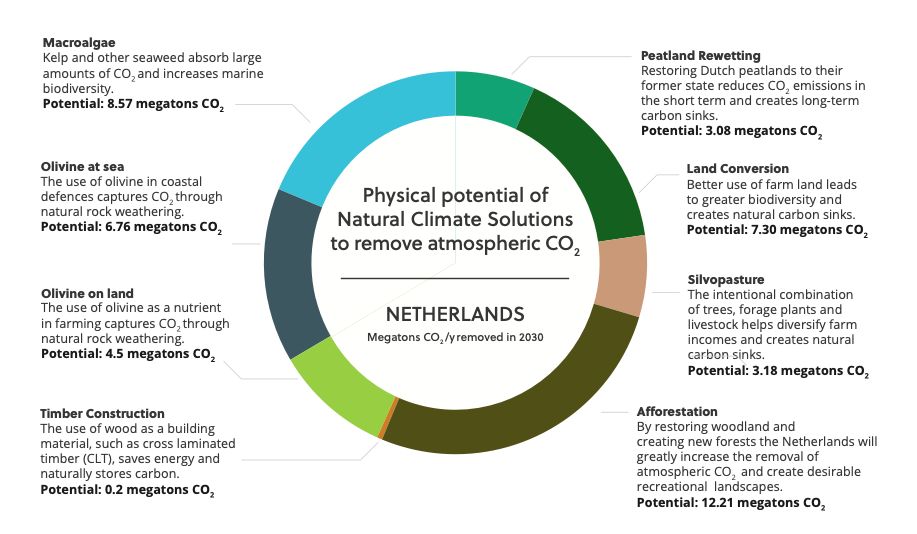
In 2022 Climate Cleanup estimated the physical potential of these solutions in the Netherlands, building on Griscom and WWF. Each segment is a solution and the megatonnes of CO₂ a year it could remove by 2030. These are potentials, not forecasts: they show where the room is.
Working alongside others
Climate Cleanup is one of many working on this, and the work is stronger connected. In Wageningen, Wageningen University & Research, where Tim van Hattum leads the Green Climate Solutions programme, drew up A nature-based future for the Netherlands in 2120: a picture of the country a century from now in which nature and natural processes play a leading role, and solutions for climate and biodiversity go hand in hand. That vision has since grown into NL2120, a national programme of companies, knowledge institutions and governments funded by the National Growth Fund.
WWF, whose work our Double Nature estimate builds on, sets out what high-quality nature-based solutions for climate look like: projects that improve livelihoods, protect and restore nature, and reduce or remove carbon at the same time, with the rights of local communities respected.
Our part is the counting: making the carbon these solutions take back measurable, so that the people doing the work can be funded for it.
REAL OR NOT
How to tell a real result from a claim
Nature-based solutions attract big promises, and not all of them hold. Europe's Carbon Removals and Carbon Farming Regulation (CRCF, 2024) sets four tests for a removal to be certified. They are good questions to ask of any project:
A project that cannot answer these with data is making a claim, not delivering a result.
Counting it: Oncra
Climate Cleanup started Oncra, Open Natural Carbon Removal Accounting, so that farmers, foresters, seaweed growers and builders can prove what they store. Oncra certifies removal only, through nature-based solutions, in land, ocean, rock and construction. Each certificate stands for one tonne of CO₂ removed, calculated from measurements on site, and every project is listed on a public registry anyone can inspect.
Measuring carbon is half the story. Oncra's Life Oracle is an open standard that reads how life on a piece of land is doing, from satellite images, a sound recorder and a soil probe, so the return of life can be shown and not only assumed.
Go deeper
Start with the basics of carbon removal, or see how a tree's carbon is actually counted.
Sources
- Resolution 5/5: Nature-based solutions for supporting sustainable development (UN Environment Assembly, 2022)
- Natural climate solutions (Griscom et al., PNAS, 2017)
- Regulation (EU) 2024/3012, the CRCF (European Union, 2024)
- Nature-based solutions (IUCN)
- A nature-based future for the Netherlands in 2120 (Wageningen University & Research)
- NL2120 (Wageningen University & Research)
- Nature-based solutions for climate (WWF)
- Oncra registry (Oncra)
More of this work in your inbox
An occasional update on what we shipped, learned, or are about to try. Unsubscribe anytime.
Al suscribirte aceptas recibir novedades ocasionales de Climate Cleanup. Te enviaremos un enlace para confirmar. Puedes darte de baja cuando quieras.