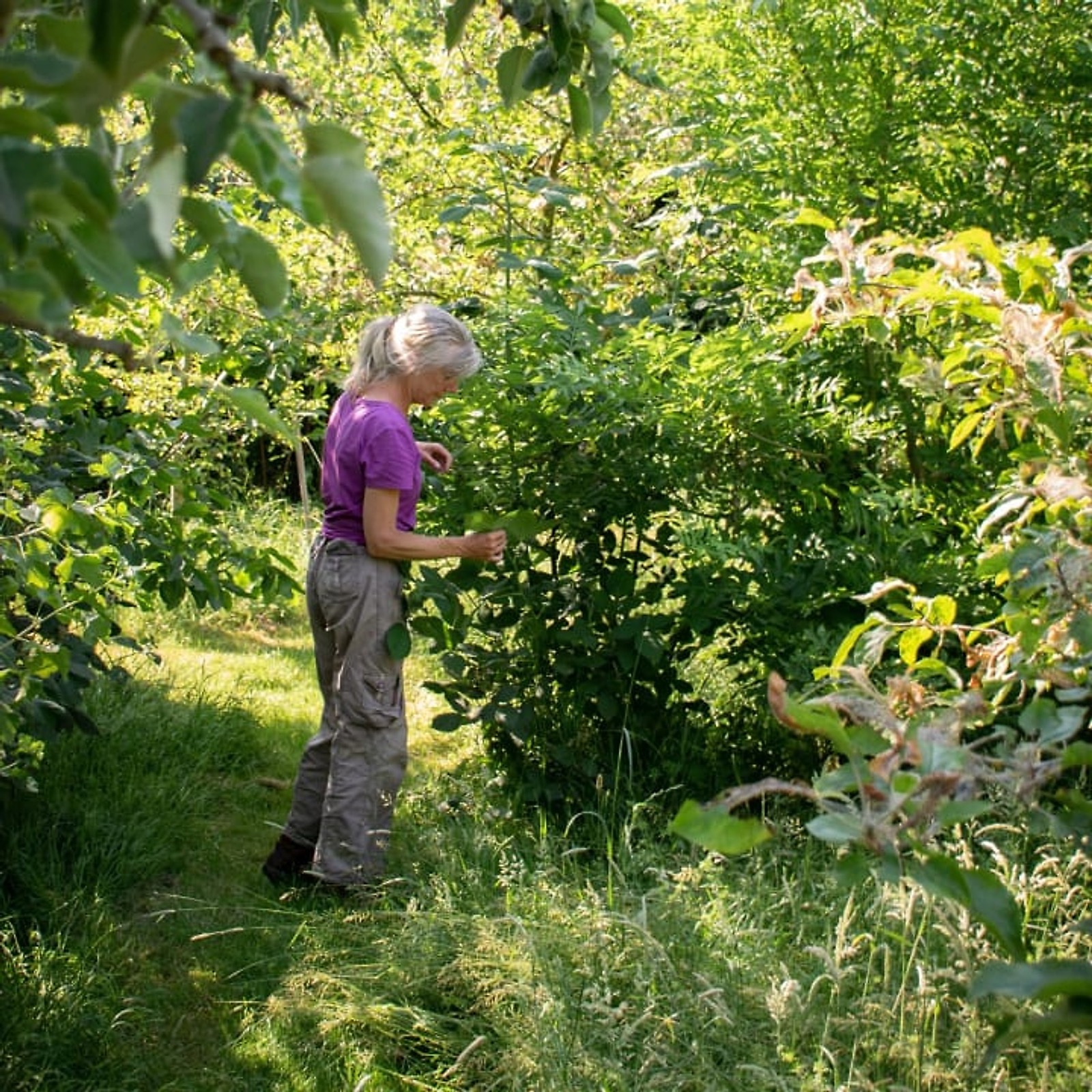

Does planting trees remove CO₂?
Yes, while the tree grows and for as long as it stands. How much depends on the species, the place and the years. Here is how a tree's carbon is counted, what makes tree planting work for the climate, and what a tree-planting carbon credit should prove.
The short answer
A tree takes CO₂ from the air through its leaves, keeps the carbon and releases oxygen. The carbon ends up in its trunk, branches and roots, and part of it in the soil around them. About half of the dry weight of wood is carbon (IPCC Guidelines, Volume 4).
So a growing tree removes CO₂. But the carbon only counts for the climate if three things hold: the tree survives, the carbon stays put for decades, and the tree would not have grown there anyway.
THE METHOD
How much CO₂ does a tree absorb?
There is no single number. A sapling adds only a little carbon each year, a vigorous tree in its prime adds far more, and an old tree grows slowly again. Species, soil, water and climate change the result many times over. That is why a figure "per tree" means little without the method behind it. This is how foresters and carbon standards count:
A worked example. Say the formula puts a tree, roots included, at 1,000 kg of dry wood. That holds about 470 kg of carbon (1,000 × 0.47), which is about 1,720 kg of CO₂ (470 × 3.67) taken out of the air over the tree's life so far.
What makes tree planting work for the climate
Planting trees cannot replace cutting emissions. It is part of the second half of the climate solution: taking carbon back.
CREDITS
Tree planting carbon credits
A carbon credit, or certificate, stands for one tonne of CO₂ removed from the air. For trees, a good one should prove:
Europe's new CRCF regulation asks the same questions of carbon farming, including forests and agroforestry.
Climate Cleanup does not sell trees or plant them for you. We started Oncra, which certifies nature-based carbon removal on land, at sea, in rock and in buildings. Each certificate stands for one tonne of CO₂ removed, calculated from measurements on site, and listed on a public registry. If you want to fund real removal, that is where to look.
Go deeper
Trees are one of many ways nature takes carbon back. See the whole picture.
Sources
- 2006 IPCC Guidelines, Volume 4: Agriculture, Forestry and Other Land Use (IPCC, 2006)
- Restoring natural forests is the best way to remove atmospheric carbon (Lewis et al., Nature, 2019)
- Tree planting in organic soils does not result in net carbon sequestration on decadal timescales (Friggens et al., Global Change Biology, 2020)
- Mapping carbon accumulation potential from global natural forest regrowth (Cook-Patton et al., Nature, 2020)
- Regulation (EU) 2024/3012, the CRCF (European Union, 2024)
- Oncra registry (Oncra)
More of this work in your inbox
An occasional update on what we shipped, learned, or are about to try. Unsubscribe anytime.
Al suscribirte aceptas recibir novedades ocasionales de Climate Cleanup. Te enviaremos un enlace para confirmar. Puedes darte de baja cuando quieras.