One day. More than 200 policymakers, entrepreneurs, scientists and financiers. One question: how do we scale natural carbon sequestration in a way that works for climate, nature and society?
The Dutch Minister of Agriculture opens the summit
The day opened with a message from The Hague. Jaimi van Essen, Minister of Agriculture, Fisheries, Food Security and Nature, addressed the summit in a video message and set the tone at once: nature is not a cost, it is climate infrastructure.
Video message from Minister Jaimi van Essen (Ministry of Agriculture, Fisheries, Food Security and Nature) at the opening of the summit. In Dutch.
“The Ministry of Agriculture is proud to be one of the founders of the national approach to biobased construction. With carbon certificates we show that we can store more carbon, reliably.”
The story of the day
It is not about carbon. It is about life.
In his opening words, Climate Cleanup director Sven Jense turned the frame around. Carbon is measurable, and that makes it financeable. But it is a proxy. What really matters is life: the same hectare that stores carbon also holds water, restores the soil, cuts nitrogen and gives the region work. One movement, nearly every goal at once. The day was dedicated to Marjan Minnesma, in her spirit: just do it, and keep going.
“Carbon is life. We are life. Put life at the centre and it starts to grow again.”
And it is not a dream: the alternative has already begun. Oncra, a legal entity of its own since January, is the only platform in the world that certifies natural, living carbon sequestration exclusively, and does so for small regenerative entrepreneurs too, so a food forest takes part as fully as anyone.
584,521
tonnes of CO₂ quantified+221% in one year
€1.1M
in value to farmers and buildersmore than doubled
140+
removers in the open registry
4
domainsLand · Construction · Ocean · Rock
Figures from the open Oncra registry as presented at the opening, June 2026. The current figures are on registry.oncra.org.
The day in pictures
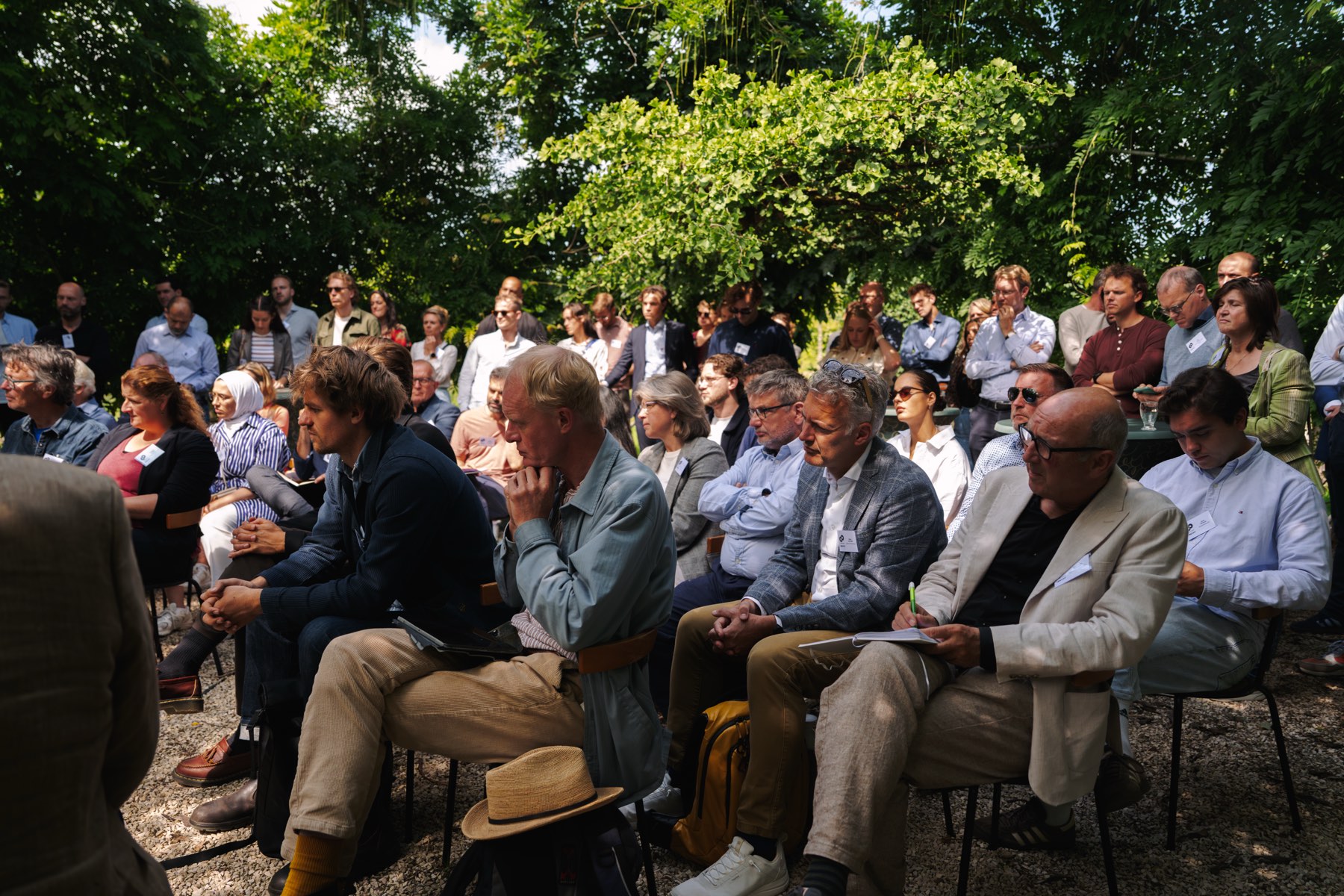
Outdoors, at the Rijkskwekerij in Baarn
A day of meeting: in the greenhouse, under the trees and along the lanes of the old national tree nursery.
The harvest
The key conclusions
Three keynotes told one story together: science says it must happen (Tim van Hattum), economics shows how it fits (Irene van Staveren), and transition studies show it is already happening (Derk Loorbach). From them, and from the three tracks, come six conclusions.
01
Nature is a third of the solution, and gets three percent of the finance
Natural climate solutions can deliver a third of cost-effective mitigation worldwide. Closing that mismatch is exactly what this day was for.
Keynote Tim van Hattum (WUR)
02
We are leaving fossil fuels, whether we like it or not. So the time is now
Until we get there, it is crisis. Crises are the openings; momentum comes by itself but cannot be predicted. “So it is now.”
Keynote Derk Loorbach (DRIFT)
03
Restoring nature and natural sequestration are good regardless, and getting better
Amid all the market criticism, the underlying practice stands firm. The regime pushes back (“capture and backlash”), so we keep working transitionally: normative, collective, creative, reflexive.
Keynote Derk Loorbach (DRIFT)
04
Reduction first. Sequestration is the bridge of the transition, not a licence to keep emitting
Solar and batteries are the fastest, most efficient lever. Sequestration finances the transition, with strict certification (permanence, additionality), not as trade in emission rights.
Keynote Irene van Staveren (Erasmus) and the market track
05
The business case is strong and countable: billions a year
In the Netherlands alone: natural carbon sequestration ~€31 bn a year, biodiversity €40 bn, water quality €17 bn, nitrogen reduction €15 bn, avoided climate damage €7 bn, health €5 bn. By 2050 the value to society rises to €500 bn.
Keynote Tim van Hattum (WUR) · New Economy
06
It already works, and Climate Cleanup and Oncra measure and certify it
584,521 tonnes of CO₂ quantified, €1.1M to farmers and builders, 140+ removers. The infrastructure to measure and certify natural carbon sequestration in the Netherlands is in place, and growing.
Oncra registry, June 2026
“Whoever keeps seeing nature as a cost misses that it is becoming a new economic infrastructure. The Netherlands can lead the world here.”
The scientific ground: nature is our most important climate ally. From “champion of engineering” to “champion of nature”: green where we can, grey where we must. NL2120 as a hopeful, integrated picture of the future.
The economics underneath. Reduction remains the most effective lever; carbon sequestration is a strong second best: as a reward for the common good, certified under strict conditions, not as tradable offsetting.
The movement has already begun. We are leaving the fossil system, whether we like it or not; removers are the frontrunners of the new system. Beware of regime capture, and act transitionally: “keep stumbling forward.”
Break-out sessions, round 2, and the live Ecosofie podcast (Marnix Kluiters with Sven Jense)
Policy From barriers to regional next steps
Market Why buy carbon certificates?
Construction Carbon in the land-development and operating budgets (GREX and VEX)
16:00
Plenary closing and keynote: On to the next crisis
Derk Loorbach, DRIFT
16:30
Drinks at the Carbon Market, with dozens of initiatives
17:30
Walking dinner
The break-out sessions
Three tracks, one task
In two rounds, participants worked along three tracks: policy, market and finance, and biobased construction. Below, the core of each track, with all slides and materials to read on (in Dutch).
PolicyInterprovincial Carbon Coalition (IPKC) · moderator Zoë Red
Cooperation between layers of government
Policy advisers from provinces, municipalities and the ministry took stock of what is already under way, where the bottlenecks are and who takes which role. The IPKC's course: “natural where possible, technical where necessary, and always together with emission reduction”, with the Oxford Principles as the safeguard against greenwashing. The province emerges as the logical connector and director between national ambition and regional delivery.
First a shared story. Provinces, municipalities and the national government must say with one voice what carbon sequestration is, what it is not, and who plays which role. Otherwise cooperation stalls in coordination problems.
Then volume. “Government has to give the first push”: as the first customer, through procurement, tenders and subsidies. As long as scale is missing, the business case stays fragile.
The task is organisational, not technical. Certification under CRCF/VCM is both the biggest bottleneck and the biggest opportunity: investment flows once the rules of the game are clear.
National government and the EU at the table. A concrete recommendation: a follow-up with the national government and Europe, to settle questions about finance (including SDE++) and the balance between national and regional, and to prevent fragmentation.
Marketmoderator Gijs Tolmeijer (Climate Cleanup and Oncra)
Market and finance
In the morning from the project owner's side (“how do you value sequestration?”), in the afternoon from the buyer's (“why buy certificates?”). Two fishbowls with, among others, BambooLogic, Regreener, Scature, Nationaal Groenfonds, Microsoft, Rabo Carbon Bank and Mobility Invest Group.
Certificates are a bridge, not a destination. They help a new crop or a biobased supply chain over the threshold, and ideally become unnecessary once that chain stands on its own feet.
Trust and standards are the condition for scale. Buyers get lost in the jungle of certificates and prices (€100 against €0.25). The answer: external ratings, the move to CRCF/ICVCM, and one shared Dutch registry (SNK and Oncra).
The mitigation hierarchy is undisputed: reduction first, removal for the last ~5% and for historical emissions, preferably through insetting within one's own supply chain.
The breakthrough is on the balance sheet: get carbon (and nature) on the balance sheet, with accounting rules, tied-up capital and KPIs. “Once one accountant signs, the rest follow.”
Constructionmoderator Sacha Brons (Climate Cleanup and Building Balance)
Biobased construction
Construction is both the problem and the pump: 37% of Dutch emissions come from construction and real estate, 11% from building materials. But biobased construction can turn that around and store carbon in the building stock (“a land-to-building pump”). With, among others, Jurriaan van Stigt (LEVS architecten) and the GREX/VEX session by Stratego Advies, Stadkwadraat and Alba Concepts.
No CO₂ budget, no real plan. “A national spatial plan without a CO₂ budget is like a household budget without amounts.” First keep, then reuse, then biobased as the default with storage, and steel and concrete only where needed.
From storage to revenue. The GREX/VEX models showed that pricing CO₂ storage (~€80 a tonne), plus shorter build times and longer operation, lifts a timber-building business case from −21% to +4%.
The supply is already there. The Netherlands can build ~50,000 industrial, biobased homes a year from existing, built concepts: up to 84% biobased and more than 430 kg of CO₂ stored per m².
The open question is who owns the credits, and that is exactly Oncra's role: a verifiable standard (Construction Stored Carbon, aligned with the CRCF). Builders are already asking for certification of real projects.
During the second round, Marnix Kluiters recorded an episode of the Ecosofie podcast live with Sven Jense: start not from the problem but from a goal, double life. With questions from the audience on decentralisation, inner revolution and whether silence can save us from climate change.
Voices from science, farming, nature, finance and politics sent a message to the opening of the summit. In Dutch.
Aniek MoonenJonge Klimaatbeweging (Dutch Youth Climate Movement)“Not just bracing for the short term, but building resilience for the long term.”Barbara Baarsmaeconomist“Healthy soil: our greatest ally, and also the most underrated.”Steff RoellTrees4All“The right tree in the right place. Every tree counts.”Willem FerwerdaCommonland“Carbon sequestration as part of the landscape-restoration industry that is emerging everywhere.”Alex DatemaRabobank“Carbon sequestration adds value: on the farm, for nature and for the climate.”
Climate positive
This summit cleaned up its own emissions, twice over
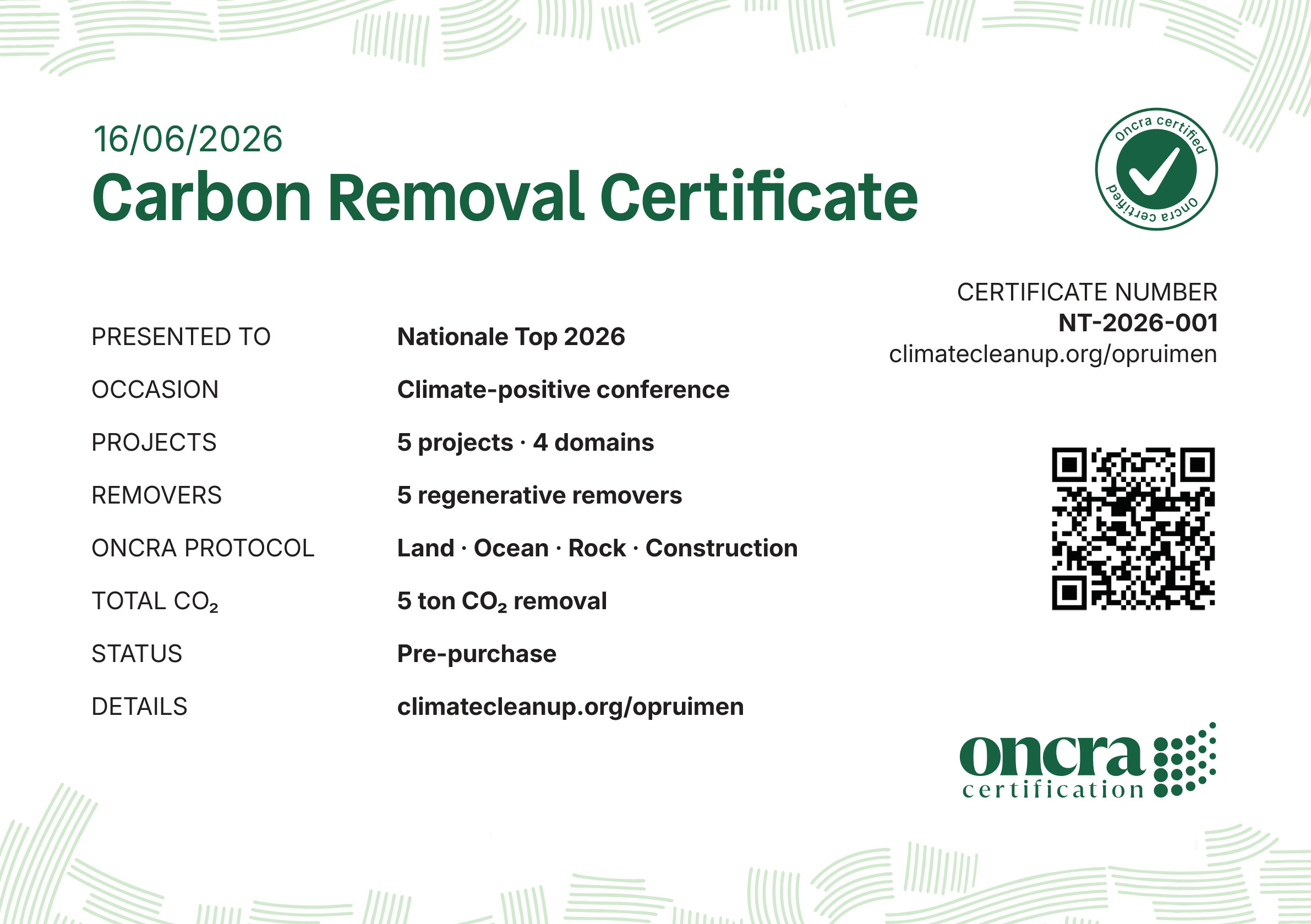
Every participant took a certificate home
Climate Cleanup made the summit climate positive. The day emitted about 2.4 tonnes of CO₂; we had 5 tonnes cleaned up, more than double, by five regenerative removers in Land, Ocean, Rock and Construction. Every tonne can be checked in the open Oncra registry.
Four days on ocean, rock weathering, land and biobased construction: a radically positive plan to turn climate, nitrogen and biodiversity around at once.
Clean up your residual emissions with verifiable sequestration, and help the removers with finance up front. Directly through the registry or through a broker.
Questions, an idea or a collaboration? Email us at top@climatecleanup.org. Thank you to everyone who was there: policymakers, entrepreneurs, scientists and financiers. Together we put nature on the Dutch balance sheet.
Partners
Climate Cleanup organised the summit with Oncra and six provinces: Gelderland, Utrecht, Noord-Holland, Zuid-Holland, Noord-Brabant and Drenthe. Made possible by forward-looking partners working together on climate solutions.